
Digital Dental Charting vs. Paper Records for Periodontal Assessments
Digital dental charting wins where periodontal care is most demanding: capturing precise millimeter measurements and tracking subtle changes over time. For decades, paper records were the standard for documenting patient information, clinical findings, and treatment plans, but illegible handwriting, manual calculation errors, and tedious data retrieval undermine accuracy exactly where periodontal assessment needs it most. This post compares digital dental charting against traditional paper records, evaluating which method delivers superior accuracy for periodontal assessments and how each affects data integrity, diagnostic precision, workflow efficiency, and patient outcomes.
Denti360, at the forefront of dental healthcare and technology, understands how much accurate record-keeping shapes patient care. With periodontal health, the choice between digital and paper is more than preference; it influences diagnostic reliability, treatment efficacy, and the patient experience. Here is why digital charting is emerging as the champion for accurate periodontal assessments.
The Foundation: What a Periodontal Assessment Measures
A comprehensive periodontal assessment evaluates the health of the tissues supporting the teeth through a series of measurements and observations. Key components typically include:
- Probing Depths: Measurement in millimeters of the sulcus or pocket depth.
- Gingival Recession: Measurement of the apical migration of the gingival margin.
- Clinical Attachment Loss (CAL): Calculated from probing depth and gingival recession, representing the true loss of connective tissue attachment.
- Bleeding on Probing (BOP): Indicates inflammation and active disease.
- Suppuration: Presence of pus, another sign of active infection.
- Mobility: Assessment of tooth movement.
- Furcation Involvement: Evaluation of bone loss in multi-rooted teeth.
- Plaque and Calculus Indices: Documentation of biofilm and hardened deposits.
- Radiographic Interpretation: Analysis of bone levels and patterns of bone loss.
Each parameter contributes to a holistic understanding of the patient's periodontal status, guiding diagnosis, prognosis, and treatment planning. Accurate, consistently documented measurements are paramount for managing disease and monitoring progression over time.
Traditional Paper Records: A Legacy of Documentation
Paper records were the backbone of dental practices for generations. Their familiarity and simplicity made them reliable, and many practitioners still use them. Here is how they perform for periodontal assessments.
Advantages of Paper Records
- Tactile Familiarity: Many clinicians find writing and sketching intuitive and direct.
- No Hardware or Software Dependencies: Paper requires no computers, software, or internet, eliminating concerns about system crashes or glitches.
- Easy to Annotate: Quick handwritten notes or diagrams can be added during an examination.
- Low Initial Cost: Charts, pens, and filing cabinets cost relatively little upfront compared to digital systems.
Disadvantages of Paper Records for Periodontal Assessments
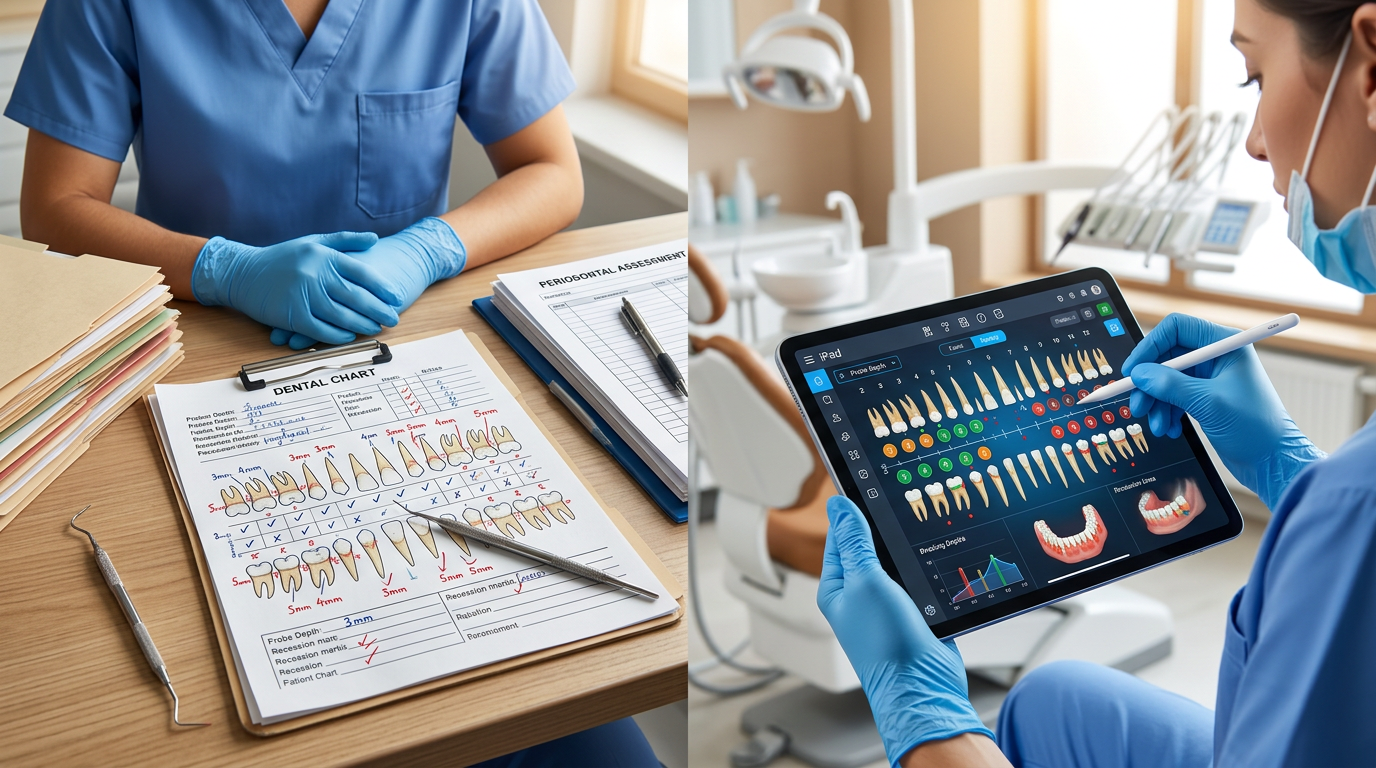
- Legibility and Consistency Issues: Handwriting varies between clinicians, leading to misinterpretation. Inconsistent abbreviations or conventions complicate understanding.
- Error Proneness: Manual entry of measurements and CAL calculations is susceptible to human error, and transcribing data between forms adds risk.
- Time-Consuming Documentation: Recording each probing depth, recession, and finding for every tooth is lengthy, and calculating CAL on the fly slows the assessment.
- Difficult Data Retrieval and Analysis: Searching historical data, comparing measurements over time, or spotting trends across records is tedious and often impractical.
- Space and Storage Concerns: Paper requires significant physical storage, and retrieval and refiling consume time.
- Vulnerability to Damage or Loss: Charts are susceptible to spills, fire, or misplacement, and a lost chart means a lost history.
- Limited Data Sharing: Sharing with specialists requires physical transfer or photocopying, which is inefficient and less secure.
- Lack of Standardization: Varying templates across clinicians or offices make comparison and aggregation challenging.
For periodontal assessments, where precise millimeters and consistent documentation are vital, these limitations significantly impede accuracy, efficiency, and the ability to track subtle disease progression.
Digital Dental Charting: The Modern Solution
Digital dental charting uses software to record, store, and manage all patient data, including comprehensive periodontal assessments. This technology has revolutionized practice operations and offers a host of advantages over traditional methods.
Advantages of Digital Dental Charting for Periodontal Assessments
- Unmatched Accuracy and Precision:
- Automated Calculations: Systems automatically calculate clinical attachment loss (CAL) from probing depths and recession, eliminating human calculation errors and ensuring consistent accuracy.
- Standardized Input: Pre-defined fields and drop-down menus enforce standardized entry, minimizing variability and capturing every critical parameter.
- Real-Time Data Entry: Voice-activated sensors or foot pedals let hygienists or assistants record data as it is called out, reducing transcription errors and improving efficiency.
- Enhanced Legibility and Consistency: Records are always clear, legible, and uniformly formatted regardless of who enters the data, so any team member can interpret the patient's status accurately.
- Efficient Data Retrieval and Analysis:
- Instant Access: Records are available from any networked workstation, saving time.
- Trend Analysis: Software generates graphical views of periodontal data over time, letting clinicians track probing depths, CAL, and BOP, which is invaluable for monitoring progression, evaluating treatment, and educating patients.
- Customizable Reports: Generate detailed, professional reports for patients, specialists, or insurers with ease.
- Improved Workflow and Time Savings:
- Faster Charting: Intuitive interfaces and automation make full-mouth periodontal charting significantly faster than manual methods.
- Reduced Administrative Burden: No filing, retrieving, or organizing physical charts, freeing staff for critical tasks.
- Superior Data Integration: Digital charting often integrates with practice management software, digital imaging, and treatment planning, creating a holistic, interconnected patient record.
- Enhanced Patient Education and Engagement:
- Visual Aids: Clinicians display charts, graphs, and images on a chairside monitor so patients understand their condition and recommended treatment.
- Increased Compliance: When patients visually grasp the extent of disease, they engage more and adhere to home care.
- Robust Security and Backup: Digital systems offer access controls, encryption, and regular local and cloud backups, reducing the risk of loss or unauthorized access through role-based access.
- Eco-Friendly: Reduces paper consumption for a more sustainable practice.
Challenges of Digital Dental Charting
- Initial Investment: Hardware, software licenses, and training carry a substantial upfront cost.
- Learning Curve: Staff need time and training to become proficient.
- Technical Dependencies: Reliance on computers, networks, and connectivity means potential disruption if systems fail.
- Data Security Concerns: Though generally more secure than paper, digital systems remain vulnerable to cyber threats if not properly protected and updated.
Despite these challenges, the long-term benefits of digital charting, particularly the precision and efficiency periodontal assessments demand, far outweigh the initial hurdles.
Direct Comparison for Periodontal Assessments: Digital vs. Paper
Here is how each system performs on the aspects most crucial for accurate periodontal assessments.
Accuracy and Reliability
- Paper: Highly susceptible to human error in transcription, CAL calculation, and legibility. Inconsistent methods further reduce reliability.
- Digital: Automates CAL calculations, enforces standardized entry, and ensures perfect legibility, providing a trustworthy foundation for diagnosis and treatment.
Efficiency and Workflow
- Paper: Time-consuming manual entry, calculation, and physical record management, with slow retrieval.
- Digital: Streamlined input via voice or foot pedal, automated calculations, instant retrieval, and easy trend analysis, significantly reducing chair time and administrative burden.
Data Analysis and Trend Tracking
- Paper: Extremely difficult to track changes in probing depths, CAL, or BOP across appointments without laborious manual comparison.
- Digital: Excels here, generating clear graphs and reports that instantly highlight trends for better long-term management and prognosis.
Patient Education and Engagement
- Paper: Limited ability to demonstrate conditions beyond verbal explanation.
- Digital: A powerful education tool, displaying visual representations of periodontal health to foster understanding and compliance.
Security and Compliance
- Paper: Vulnerable to loss, damage, and unauthorized access, and compliance with privacy regulations such as HIPAA is challenging without stringent physical security.
- Digital: Offers access controls, audit trails, and robust backup, facilitating easier compliance with data privacy regulations.
Integration With Other Technologies
- Paper: No integration; a standalone system.
- Digital: Integrates with practice management software, imaging, and other dental technologies for a unified patient record.
The Denti360 Perspective: Embracing the Digital Future
At Denti360, we advocate digital dental charting as a cornerstone of modern practice, especially for periodontal assessments. Capturing, analyzing, and presenting periodontal data with unmatched accuracy and efficiency translates directly into superior patient care. For dental professionals, that means:
- More Precise Diagnoses: Accurate, consistently recorded data supports more informed diagnostic decisions.
- Personalized Treatment Plans: Detailed trend analysis enables highly customized, adaptive strategies.
- Improved Patient Outcomes: Better diagnosis and treatment lead to healthier patients and greater success managing periodontal disease.
- Enhanced Practice Efficiency: Streamlined workflows free time to see more patients or focus on complex cases.
- Stronger Patient Relationships: Visual aids build trust and encourage active participation in oral health.
The transition from paper to digital may seem daunting, but the long-term benefits for practice and patients are undeniable. Investing in robust charting software and adequate patient management training are crucial steps toward maximizing these advantages.
Implementation Considerations for Digital Charting
For practices switching or upgrading, several factors drive successful implementation:
- Software Selection: Choose intuitive, comprehensive software that integrates with existing practice management systems, with periodontal-specific features such as automated CAL, graphical representations, and customizable templates.
- Hardware Infrastructure: Ensure adequate workstations including chairside monitors, reliable connectivity, and robust servers or cloud storage.
- Staff Training: Allocate sufficient time for staff to learn the system, practice data entry, and understand its full capabilities, with ongoing support and refreshers.
- Data Migration: Plan to migrate existing paper data gradually or through professional conversion services.
- Security Protocols: Implement strong passwords, user access controls, regular backups, and cybersecurity measures to protect patient information.
With careful planning, practices can transition smoothly to digital charting and immediately begin reaping the rewards.
Elevate Your Periodontal Charting With Denti360
Compared head-to-head, digital dental charting decisively outperforms paper for accurate periodontal assessments. Paper records hold a nostalgic appeal and basic functionality, but legibility issues, error proneness, inefficiency, and weak analytics directly undermine the precise, consistent measurements periodontal care requires. Digital charting answers with automated calculations, standardized entry, real-time analysis, and seamless integration, empowering professionals to deliver the highest standard of care. As the industry moves into 2025 and beyond, embracing digital charting is an essential investment in diagnostic precision and patient outcomes. Discover how Denti360 supports your transition by exploring our platform features or reaching out through our contact page.