
Digital vs. Manual Dental Charting: Which Wins on Precision and Efficiency?
Digital dental charting versus manual charting is the decision quietly shaping your accuracy, your chairside speed, and your compliance risk every single day. If illegible notes, slow transcription, and overflowing paper archives are costing your team time and confidence in their records, the method you choose matters more than it seems. For centuries, dental care has rested on meticulous record-keeping, from initial assessments to tracking treatment progress, and charting is the backbone of any comprehensive oral health strategy. Traditionally this was done manually with pen, paper, and intricate symbols. With rapid advances in dental technology, digital dental charting has emerged and forced a critical question: which method offers superior accuracy and efficiency? At Denti360, precision and streamlined workflows are paramount to exceptional patient care. This post compares digital and manual charting in detail, exploring their advantages, disadvantages, and impact on diagnostics, treatment planning, and overall patient management.
Manual Dental Charting: The Traditional Approach
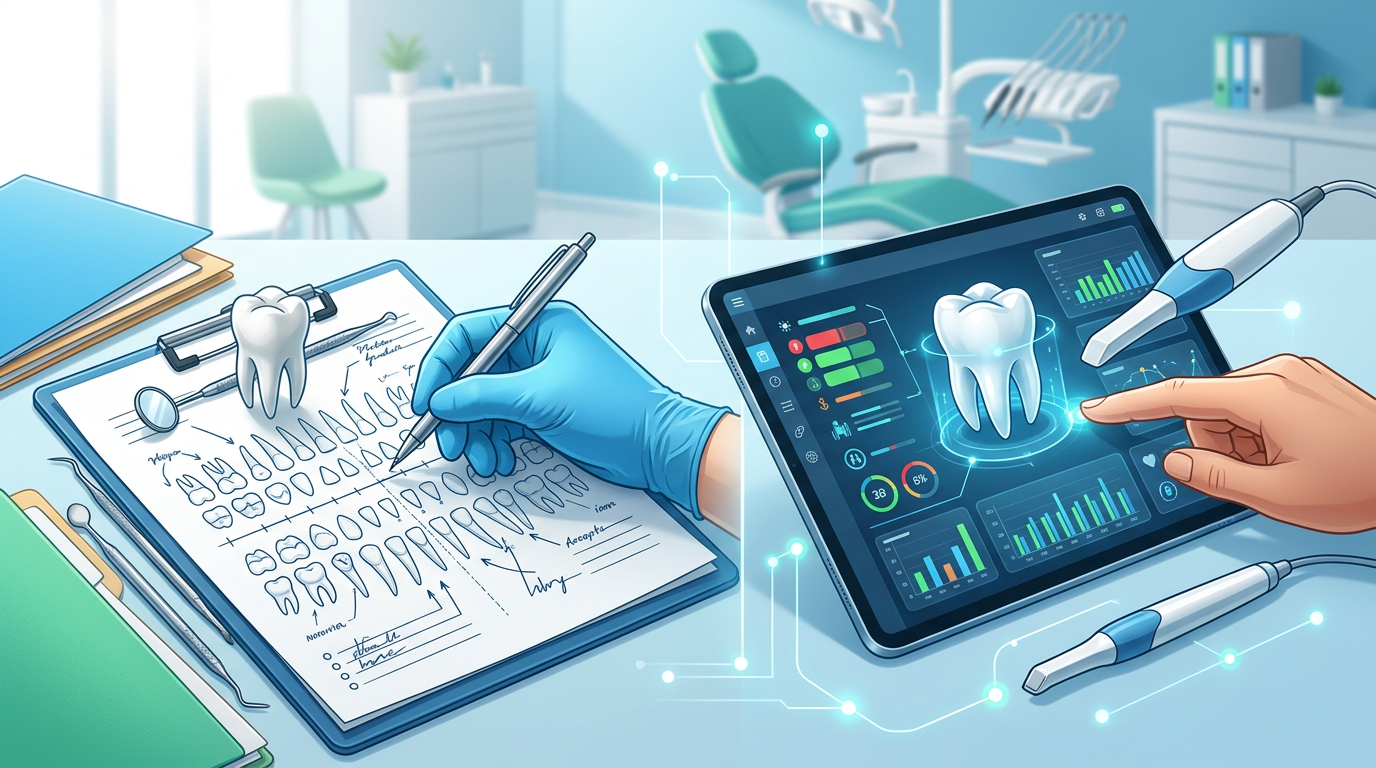
Manual charting has been the industry standard for generations. It uses pre-printed paper charts, specialized pens, and a standardized set of symbols and abbreviations to document each tooth's condition, periodontal health, existing restorations, and pathologies. Dental assistants or hygienists meticulously transcribe findings dictated by the dentist, marking diagrams and writing notes.
Advantages of Manual Charting
- Simplicity and Low Cost: Setup is minimal, requiring only paper charts, pens, and storage. This low entry barrier has historically made it accessible regardless of budget.
- Tactile Familiarity: Many experienced professionals are deeply comfortable with the tactile process. The physical act of writing can aid memory recall and allow quick, on-the-spot annotations without relying on technology.
- No Dependency on Technology: Manual charts are immune to power outages, software glitches, and hardware failures. Where technological infrastructure is unreliable, manual charting offers a failsafe.
Disadvantages of Manual Charting
- Prone to Human Error: Illegible handwriting, transcription mistakes, missed entries, and inconsistent symbols can lead to misinterpretation and inaccurate records.
- Time-Consuming: Dictating findings, waiting for transcription, and meticulously marking charts consumes valuable chairside time better spent on patient care.
- Storage and Retrieval Issues: Physical charts demand significant space and burden growing practices. Retrieving records is slow in large archives, and charts can be misplaced or damaged.
- Lack of Standardization: Even with standard symbols, individual practices or clinicians develop variations, creating inconsistencies that hinder seamless information exchange.
- Limited Data Analysis: Manual charts offer little capacity for analysis. Trends in patient health, condition prevalence, or treatment outcomes are very difficult to quantify across a population.
- Security Concerns: Paper charts are vulnerable to unauthorized access, fire, flood, and physical damage, posing significant security and data integrity risks.
Digital Dental Charting: The Modern Solution
Digital charting uses specialized software to record, store, and manage patient records electronically. It typically integrates with a practice management system for a holistic view of patient information, including medical history, radiographs, treatment plans, and billing. Clinicians input data directly via mouse, keyboard, or touch screen, using pre-defined templates and intuitive graphical interfaces.
Advantages of Digital Charting
- Enhanced Accuracy and Consistency: Standardized templates, drop-down menus, and automated prompts ensure consistent, accurate data entry. Illegible handwriting is eliminated and symbol usage is uniform.
- Improved Efficiency and Time Savings: Pre-filled fields, one-click selections, and voice recognition (in advanced systems) accelerate charting and free chairside time. Record retrieval is instantaneous, enhancing workflow and reducing patient wait times.
- Comprehensive Data Management: Digital systems store vast information, including high-resolution images, radiographs, intraoral scans, and 3D models, for a richer, more detailed record.
- Advanced Data Analysis and Reporting: Practices easily generate reports on demographics, common diagnoses, treatment success rates, and compliance, offering invaluable insights for improvement and research.
- Enhanced Communication and Collaboration: Records can be securely shared with specialists, labs, or insurers instantly, streamlining referrals and improving continuity of care.
- Superior Security and Backup: Robust encryption, access controls, and audit trails protect patient privacy and support HIPAA compliance, while automated backups guard against data loss.
- Environmental Friendliness: Reducing paper reliance contributes to a more sustainable practice.
- Integration with Other Technologies: Digital charting integrates seamlessly with digital radiography, intraoral cameras, CAD/CAM systems, and patient education software, creating a cohesive ecosystem that enhances diagnostics and patient understanding.
- Patient Engagement: Digital charts visually demonstrate conditions and treatment plans on screen, fostering understanding and adherence.
Disadvantages of Digital Charting
- Initial Investment Cost: Upfront costs for software, hardware (computers, servers), and network infrastructure can be substantial, a barrier for some practices.
- Learning Curve and Training: Implementing a new system requires training the entire team, and staff face a learning curve adapting to new workflows and interfaces.
- Technical Dependencies: Power outages, connectivity issues, software bugs, or hardware malfunctions can disrupt operations, making regular IT support and maintenance necessary.
- Data Security Risks (Cyber Threats): Digital systems offer advanced security but are not immune to cyber threats and data breaches, so robust cybersecurity measures and ongoing vigilance are essential.
Accuracy in Focus: Why Digital Charting Outperforms Manual
On the core objective of charting, accuracy, digital methods consistently outperform manual approaches. Here is why:
- Elimination of Legibility Issues: Digital records are inherently clear and readable, removing ambiguity from poor handwriting. Every entry is standardized and machine-typed.
- Standardized Data Entry: Digital systems enforce standardized terminology and entry methods, so a specific condition or treatment is always recorded the same way regardless of who enters it. This consistency is crucial for longitudinal tracking and inter-provider communication.
- Reduced Transcription Errors: Manual charting often involves a dentist dictating and an assistant transcribing, introducing errors. Direct data input by the clinician or advanced voice recognition minimizes this risk.
- Automated Validation and Prompts: Built-in validation rules and prompts prevent illogical entries or remind clinicians to record essential information, even flagging entries that contradict previous findings.
- Graphical Representation and Visual Cues: Color-coded graphical representations of teeth and periodontal conditions make issues easy to visualize at a glance, and changes over time can be overlaid or compared side by side.
- Integration with Diagnostic Tools: Seamless integration with digital X-rays, intraoral cameras, and 3D imaging provides a more complete, accurate diagnostic picture, correlating clinical findings directly with visual evidence in one record.
The Role of Denti360 in Your Digital Transformation
At Denti360, we are at the forefront of dental technology, providing innovative solutions that empower practices to thrive. Our comprehensive suite is designed to facilitate a smooth transition to digital workflows so clients gain the superior accuracy and efficiency modern technology offers. We specialize in integrated practice management software that includes robust digital charting modules, digital imaging solutions, and secure cloud-based data management, all part of our broader platform features.
We know adopting new technology can feel daunting. That is why Denti360 offers extensive training, dedicated support, and customizable solutions tailored to each practice. Our goal is not just to provide software but to partner with dental professionals in building a more efficient, accurate, and patient-centric practice for 2025 and beyond.
The Future of Dental Charting: Embracing Innovation
The trajectory of dental charting points clearly toward further digitalization and integration. Future advances are likely to include:
- Artificial Intelligence (AI): AI could increasingly analyze charted data, identify patterns, predict disease progression, and assist with diagnostic suggestions.
- Advanced Voice Recognition: More sophisticated voice-to-text charting will further reduce manual input, enhancing speed and accuracy.
- Tele-dentistry Integration: Digital charting is foundational for effective tele-dentistry, enabling remote consultations and monitoring with seamless access to records.
- Enhanced Interoperability: Greater standardization between dental software systems and other healthcare platforms will enable truly integrated patient care.
Make the Move to Digital Charting With Denti360
In modern dentistry, the debate between digital and manual charting is increasingly settled. Manual charting served its purpose for decades, but its limitations in accuracy, efficiency, data analysis, and security make it a less viable option for practices pursuing excellence in 2025. Despite its initial investment and learning curve, digital charting offers an undeniable edge: superior accuracy, streamlined workflows, stronger data security, and new avenues for analysis and inter-professional collaboration. For practices committed to the highest standard of patient care, optimizing efficiency, and future-proofing their services, embracing digital charting is a strategic imperative. At Denti360, we believe the future of dentistry is digital, precise, and integrated, elevating diagnostic capabilities, enhancing treatment planning, and improving patient outcomes. Ready to make the transition? Get in touch with Denti360 to see our digital charting in action.