
Advanced Dental Imaging: How Denti360 Is Redefining Diagnostics
Every dentist knows the frustration of a flat 2D X-ray that hides as much as it reveals. Overlapping structures obscure a fracture, a hidden canal goes unnoticed, or an implant plan rests on guesswork instead of measurement. Advanced dental imaging solves this, and Denti360 sits at the center of that shift. For decades, practices relied on film and early digital radiographs to diagnose conditions and plan treatment. That foundation built modern dentistry, but it is no longer enough for today's complex cases. Denti360's imaging technologies move beyond those limits, delivering the diagnostic clarity, treatment precision, and patient safety that modern oral healthcare demands. You can see how imaging fits the wider platform in our platform features.
Traditional Dental Imaging: Strengths and Real Limitations
To appreciate the shift Denti360 represents, it helps to understand what came before. Traditional dental imaging means conventional 2D intraoral and panoramic X-rays. These tools have served dentists worldwide, offering critical views of dental and maxillofacial structures.
Conventional 2D Radiography (Film and Early Digital)
Intraoral radiographs, both bitewings and periapical views, capture detailed images of individual teeth, their roots, and surrounding bone. Panoramic X-rays widen the view to the entire mouth, including all teeth, the jaws, the temporomandibular joints (TMJs), and the nasal sinuses. Their strengths are clear: wide availability, relatively low cost, and proven reliability for detecting common issues like cavities, bone loss, and impacted teeth.
Yet these methods carry inherent limitations:
- 2D Representation of 3D Structures: The biggest drawback is the inability to accurately represent three-dimensional anatomy. Anatomical superimposition can hide pathology, making precise diagnosis difficult in complex cases.
- Limited Soft Tissue Visualization: Conventional X-rays excel at hard tissues but show minimal detail in soft tissues, which matter for assessing lesions, infections, and certain pathologies.
- Distortion and Magnification: Projection geometry makes traditional X-rays prone to distortion and magnification, which complicates accurate measurement and can undermine treatment planning for procedures like implant placement.
- Radiation Exposure (Film): Digital radiography sharply reduced radiation, but film-based X-rays involved higher doses and longer processing times.
- Lack of Real-Time Feedback: Film required chemical processing, delaying diagnosis and planning. Even early digital systems, though faster, lacked the analytical depth of modern tools.
Denti360 Advanced Imaging: A New Era of Diagnostic Precision
Denti360 applies cutting-edge technology to overcome these limits, offering a suite of solutions that give dental professionals unprecedented diagnostic clarity, treatment precision, and patient safety. The approach centers on 3D imaging, enhanced software, and integrated workflows.
Cone Beam Computed Tomography (CBCT): The Cornerstone of Modern Dentistry
At the heart of the suite is Cone Beam Computed Tomography (CBCT). Unlike medical CT scans, dental CBCT uses a cone-shaped X-ray beam to capture high-resolution 3D images of the oral and maxillofacial regions at a lower radiation dose. It transforms the diagnostic process in several ways:
- True 3D Visualization: CBCT produces a volumetric dataset, so dentists can view anatomy from any angle, slice through tissues, and eliminate superimposition. This is critical for assessing bone density, nerve pathways, sinus anatomy, and pathological lesions.
- Superior Diagnostic Accuracy: Three-dimensional views sharpen detection of conditions easily missed on 2D images, including root fractures, accessory canals, periapical lesions, and early bone pathology.
- Precise Treatment Planning: For implant placement, orthodontics, endodontic surgery, and orthognathic surgery, CBCT is indispensable. It enables accurate measurement of bone dimensions, identification of vital structures such as the inferior alveolar nerve and maxillary sinus, and precise planning of implant angulation and depth, reducing risk and improving predictability.
- Soft Tissue Integration: Though focused on hard tissues, advanced CBCT systems can reveal soft tissue contours and relationships, especially when combined with other imaging modalities.
- Reduced Radiation Dose: Denti360's CBCT systems use low-dose protocols, delivering diagnostic 3D images with far less radiation than medical CT scans, often comparable to or only slightly higher than a full mouth series of 2D X-rays.
Intraoral Scanners: The Gateway to Digital Impressions
Beyond radiographs, Denti360 integrates advanced intraoral scanning. These handheld devices capture highly accurate 3D digital impressions of teeth and oral tissues in real time, replacing messy, uncomfortable impression materials. The benefits add up quickly:
- Enhanced Patient Comfort: No more gagging or discomfort from traditional trays and impression paste.
- Superior Accuracy and Detail: Digital impressions are remarkably precise, removing distortions common to physical impressions and producing better-fitting restorations, aligners, and appliances.
- Instant Visualization and Communication: Dentists and patients can view the 3D model immediately, improving understanding of treatment needs.
- Streamlined Workflow: Impressions go to labs electronically, cutting turnaround times and the risk of loss or damage in shipping.
- Integration with CAD/CAM: These scans anchor computer-aided design and manufacturing (CAD/CAM) workflows, enabling in-house milling of crowns, bridges, and veneers with speed and precision.
Enhanced Digital 2D Radiography and Panoramic Systems
While Denti360 champions 3D imaging, it also offers state-of-the-art digital 2D radiography and panoramic systems that far outperform older technology:
- Instant Image Acquisition: Images appear immediately, speeding diagnosis and planning.
- Reduced Radiation Exposure: Digital sensors need far less radiation than film, improving patient safety.
- Image Enhancement: Brightness, contrast, and magnification can be adjusted to reveal subtle details and sharpen diagnosis.
- Eco-Friendly: No chemical processing means no associated waste.
- Easy Storage and Retrieval: Digital images are simple to store, retrieve, and share, which streamlines practice management and referrals.
Integration and AI-Powered Analysis
What truly sets Denti360 apart is the seamless integration of these modalities alongside artificial intelligence (AI). The platform fuses CBCT data, intraoral scans, and even facial scans into one comprehensive digital patient model. AI algorithms then assist with:
- Automated Anomaly Detection: AI flags potential concerns such as caries, bone loss, or periapical lesions, supporting the dentist's diagnostic process.
- Cephalometric Analysis: Orthodontic measurements become automated and standardized, improving accuracy and efficiency.
- Implant Planning Assistance: The system suggests optimal implant positions based on bone density and proximity to vital structures.
- Predictive Analytics: Forecasting treatment outcomes and identifying potential risks becomes easier.
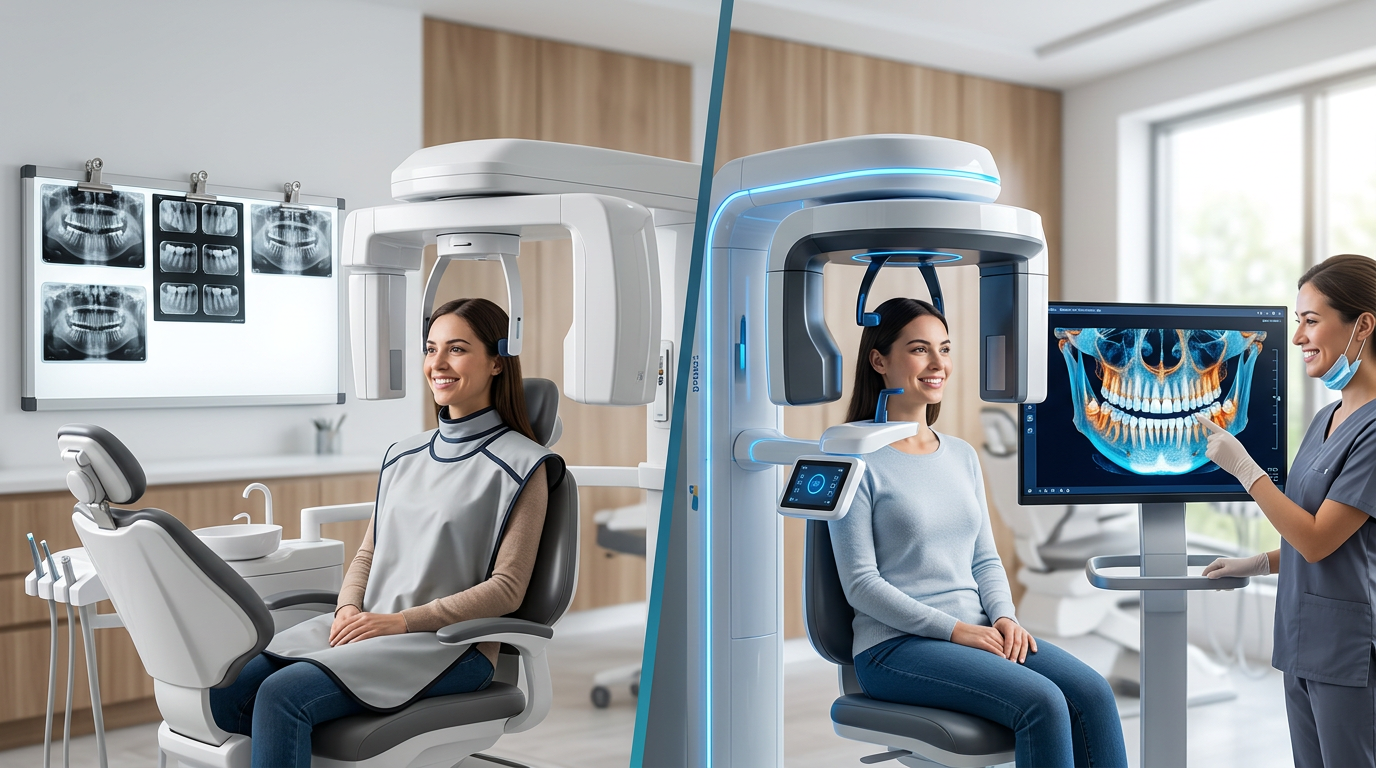
The Denti360 Advantage: Traditional vs. Advanced Imaging
Comparing Denti360's advanced imaging directly with traditional methods highlights the difference across the factors that matter most in daily practice:
- Dimensionality: Traditional imaging offers a 2D projection of 3D structures; Denti360 delivers true 3D volumetric data.
- Diagnostic Clarity: Traditional imaging is limited by superimposition and often misses subtle pathologies, while Denti360 provides unprecedented detail, eliminates superimposition, and improves detection of complex pathologies.
- Treatment Planning: Traditional methods rely on estimations from 2D views and are less precise for complex cases; Denti360 is precise, measurable, and predictable, which is vital for implants, orthodontics, and oral surgery.
- Soft Tissue Visualization: Traditional imaging shows minimal soft tissue, whereas Denti360 improves it, especially with integrated data that makes contours visible.
- Radiation Exposure: Traditional exposure varies, higher for film and lower for digital 2D; Denti360 uses optimized low-dose protocols for diagnostic-quality 3D images comparable to a full mouth 2D series.
- Patient Experience: Traditional care can be uncomfortable with impressions and film and involves longer waits, while Denti360 offers comfortable intraoral scans, faster diagnosis, and clearer communication.
- Workflow Efficiency: Traditional workflows are manual with film-processing delays and physical models; Denti360 is digital, streamlined, and real time, integrating directly with CAD/CAM and practice management systems.
- Communication: Traditional flat images are harder for patients to visualize, whereas Denti360's interactive 3D models strengthen patient education and case acceptance.
- Future-Proofing: Traditional imaging is becoming outdated for complex procedures, while Denti360 provides a platform for future AI, augmented reality, and personalized dentistry.
Applications Across Dental Specialties
Denti360's imaging solutions deliver value across the full spectrum of dentistry rather than a single specialty:
- Implantology: Unrivaled precision in surgical planning, nerve identification, and bone graft assessment.
- Endodontics: Identifies extra canals, root fractures, and complex anatomy that 2D imaging often misses.
- Orthodontics: Accurate cephalometric analysis, airway assessment, and impaction diagnosis.
- Oral and Maxillofacial Surgery: Comprehensive planning for tumor resections, trauma, and orthognathic procedures.
- Periodontics: Detailed assessment of bone loss patterns and furcation involvement.
- Restorative Dentistry: Highly accurate digital impressions for crowns, bridges, and veneers, ensuring superior fit and esthetics.
- General Dentistry: Stronger diagnostic capability for early detection of pathology, enabling more conservative, effective treatment.
The Future of Dental Care with Denti360
As we look toward 2026 and beyond, advanced imaging will no longer be a luxury but a standard of care. Denti360 stays at the forefront of this evolution, continually refining its technology to put the most sophisticated tools in dentists' hands. The vision is straightforward: every diagnosis precise, every treatment plan optimized, and every patient receiving the highest quality of care, all powered by the insights advanced imaging provides. These diagnostic gains compound when they connect to the rest of your operations, as the wider platform benefits show.
Embracing Denti360's imaging solutions means investing in diagnostic excellence, treatment predictability, and superior patient outcomes. It is a commitment to a higher standard of oral healthcare, moving beyond the limitations of the past and stepping confidently into the future of dentistry.
Conclusion
The comparison between Denti360's advanced dental imaging and traditional methods points to one trajectory: the future of dentistry is 3D, digital, and integrated. Traditional methods laid the groundwork, but they increasingly fall short of the demands of modern, complex treatment. Denti360's CBCT and intraoral scanning deliver a level of detail, accuracy, and efficiency that reshapes every part of dental practice, from clearer diagnoses to more precise planning and a better, safer patient experience. To see how advanced imaging fits a fully connected practice, book a Denti360 demo and put these tools to work in your clinic.